Interviews
Julian Barnes, The Art of Fiction No. 165
Like this interview? Read more—along with great prose, poetry, and art!—and subscribe to The Paris Review today.
Julian Barnes lives with his wife Pat Kavanagh, a literary agent, in an elegant house with a beautiful garden in north London. The long library where the interview was conducted is spacious and quiet. Overlooking the garden, it has floor-to-ceiling bookshelves, a comfortable sofa and chairs, an exercise bike in a corner (“for the winter”), and a huge billiard table. On the walls are a series of cartoon portraits of writers by Mark Boxer—Philip Larkin, Graham Greene, Philip Roth, V. S. Pritchett, among others— “some because they are very good cartoons, others because I admire the writers.” There is a superb photograph of George Sand in middle age, taken by Nadar in 1862, and a short original letter by Flaubert, a present from Barnes’s publishers when they had sold one million copies of his books in paperback. Barnes works down the corridor in a yellow-painted study with an enormous three-sided desk, which holds his typewriter, word processor, books, files, and other necessities, all of which he can reach with a swivel of his chair.
Barnes was born in Leicester in 1946 and soon after the family moved to London, where he has lived ever since. He was educated at the City of London School and Magdalen College, Oxford. After university he worked as a lexicographer for the Oxford English Dictionary and then read for the bar, while writing and reviewing for various publications. His first novel, Metroland, was well received when it was published in 1980, but it was his third book, Flaubert’s Parrot (1984), that established his reputation as an original and powerful novelist. Since then he has produced six novels, including A History of the World in 10 1/2 Chapters (1989) and The Porcupine (1992); a collection of short stories, Cross Channel (1996); and Letters from London (written when he was The New Yorker’s London correspondent). At the time of the interview his latest novel, Love, etc. had just been published in England to good reviews; it will be published in the States in February of 2001.
Tall and handsome and very fit, Barnes looks ten years younger than his fifty-four years. His well-known courtesy and charm are enhanced by acute intelligence and mordant wit. From the beginning, a passionate love of France and French literature, specifically Flaubert, has informed his work. Reciprocally, he is one of the best-loved English writers in France, where he has won several literary prizes, including the Prix Médicis for Flaubert’s Parrot, and the Prix Femina for Talking It Over. He is an officer of L’Ordre des Arts et des Lettres.
We have a great friend who is a clinical psychiatrist in Sydney; he’s always maintained that Shakespeare’s descriptions of madness were absolutely perfect accounts from a clinical point of view.
The central metaphor works like this: Metroland was a residential area laid out in the wake of the London underground system, which was developed at the end of the nineteenth century. The idea then was that there would be a Channel tunnel, and pan-European trains would run from Manchester and Birmingham, pick up passengers in London, and continue through to the great cities of the Continent. So this London suburb where I grew up was conceived in the hope, the anticipation, of great horizons, great journeys. But in fact that never came to pass. Such is the background metaphor of disappointment for the life of Chris, the hero, and of others too.
I think you hope, broadly, that your best work will survive, but how you produce your best work is perhaps a mystery— even to you. There are writers who are enormously prolific, like John Updike, whom I revere, and who has produced fifty, sixty books. The Rabbit quartet is clearly one of the great postwar American novels. But you can’t say to him, Look, would you please write the Rabbit quartet and leave it at that. Some writers are like cacti—every seven years here comes a glorious flower; then there’s another seven years of hibernation. Others can’t work like that; temperamentally they have to be writing.
The novel based on a true historical event is certainly one current literary trend at the moment. But it’s not especially new. John Banville was writing about Kepler years ago. More recently Peter Ackroyd has written about Chatterton, Hawksmoor, and Blake. Blake Morrison has just published a novel about Gutenberg. I think this is partly a question of filling a vacuum. Much history writing strikes the general reader as theoretical and overly academic. Historians like Simon Schama, who believe in the fictional virtues of narrative, character, style and so on, are rarities. Straight narrative biography is also very popular. That is probably where most nonfiction readers tend to go at the moment; so the biographical novelist hangs about the street corner, hoping to seduce a few clients away from the straight and narrow.
Author photograph by Nancy Crampton.
Julian Barnes lives with his wife Pat Kavanagh, a literary agent, in an elegant house with a beautiful garden in north London. The long library where the interview was conducted is spacious and quiet. Overlooking the garden, it has floor-to-ceiling bookshelves, a comfortable sofa and chairs, an exercise bike in a corner (“for the winter”), and a huge billiard table. On the walls are a series of cartoon portraits of writers by Mark Boxer—Philip Larkin, Graham Greene, Philip Roth, V. S. Pritchett, among others— “some because they are very good cartoons, others because I admire the writers.” There is a superb photograph of George Sand in middle age, taken by Nadar in 1862, and a short original letter by Flaubert, a present from Barnes’s publishers when they had sold one million copies of his books in paperback. Barnes works down the corridor in a yellow-painted study with an enormous three-sided desk, which holds his typewriter, word processor, books, files, and other necessities, all of which he can reach with a swivel of his chair.
Barnes was born in Leicester in 1946 and soon after the family moved to London, where he has lived ever since. He was educated at the City of London School and Magdalen College, Oxford. After university he worked as a lexicographer for the Oxford English Dictionary and then read for the bar, while writing and reviewing for various publications. His first novel, Metroland, was well received when it was published in 1980, but it was his third book, Flaubert’s Parrot (1984), that established his reputation as an original and powerful novelist. Since then he has produced six novels, including A History of the World in 10 1/2 Chapters (1989) and The Porcupine (1992); a collection of short stories, Cross Channel (1996); and Letters from London (written when he was The New Yorker’s London correspondent). At the time of the interview his latest novel, Love, etc. had just been published in England to good reviews; it will be published in the States in February of 2001.
Tall and handsome and very fit, Barnes looks ten years younger than his fifty-four years. His well-known courtesy and charm are enhanced by acute intelligence and mordant wit. From the beginning, a passionate love of France and French literature, specifically Flaubert, has informed his work. Reciprocally, he is one of the best-loved English writers in France, where he has won several literary prizes, including the Prix Médicis for Flaubert’s Parrot, and the Prix Femina for Talking It Over. He is an officer of L’Ordre des Arts et des Lettres.
INTERVIEWER
You are very European, which is unusual for an English writer, but also very English, especially to a foreigner. In France, for example, they think of you as quintessentially English. Where do you place yourself?JULIAN BARNES
I think you are right. In Britain I’m sometimes regarded as a suspiciously Europeanized writer, who has this rather dubious French influence. But if you try that line in Europe, especially in France, they say, Oh, no! You’re so English! I think I’m probably anchored somewhere in the Channel.INTERVIEWER
Sartre wrote an essay called “Qu’est-ce que la littérature?” What is literature for you?BARNES
There are many answers to that question. The shortest is that it’s the best way of telling the truth; it’s a process of producing grand, beautiful, well-ordered lies that tell more truth than any assemblage of facts. Beyond that, literature is many things, such as delight in, and play with, language; also, a curiously intimate way of communicating with people whom you will never meet. And being a writer gives you a sense of historical community, which I feel rather weakly as a normal social being living in early twenty-first-century Britain. For example, I don’t feel any particular ties with the world of Queen Victoria, or the participants of the Civil War or the Wars of the Roses, but I do feel a very particular tie to various writers and artists who are contemporaneous with those periods and events.INTERVIEWER
What do you mean by “telling the truth”?BARNES
I think a great book—leaving aside other qualities such as narrative power, characterization, style, and so on—is a book that describes the world in a way that has not been done before; and that is recognized by those who read it as telling new truths—about society or the way in which emotional lives are led, or both—such truths having not been previously available, certainly not from official records or government documents, or from journalism or television. For example, even people who condemned Madame Bovary, who thought that it ought to be banned, recognized the truth of the portrait of that sort of woman, in that sort of society, which they had never encountered before in literature. That is why the novel was so dangerous. I do think that there is this central, groundbreaking veracity in literature, which is part of its grandeur. Obviously it varies according to the society. In an oppressive society the truth-telling nature of literature is of a different order, and sometimes valued more highly than other elements in a work of art.INTERVIEWER
Literature, then, can take a lot of forms—essays, poetry, fiction, journalism, all of which endeavor to tell the truth. You already were a very good essayist and journalist before you started to write fiction. Why did you choose fiction?BARNES
Well, to be honest I think I tell less truth when I write journalism than when I write fiction. I practice both those media, and I enjoy both, but to put it crudely, when you are writing journalism your task is to simplify the world and render it comprehensible in one reading; whereas when you are writing fiction your task is to reflect the fullest complications of the world, to say things that are not as straightforward as might be understood from reading my journalism and to produce something that you hope will reveal further layers of truth on a second reading.INTERVIEWER
Did you want to be a writer at an early age?BARNES
Not at all. It is an abnormal thing to want to be an artist, to practice an art. It is comparatively normal to practice an interpretative art. But to actually make things up is not something that, well, usually runs in families or is the recommendation of a career master.INTERVIEWER
Yet England has produced some of the greatest writers, and perhaps the greatest literature, of the world.BARNES
That is a separate truth. But there is nothing when you are growing up, even as a reasonably well-educated person, to suggest that you have an authority to be more than, say, a reader, an interpreter, a consumer of art—not a producer of it. When I became a passionate reader in my teens I thought writing was something that other people did. In the same way, when I was four or five I wanted to be an engine driver, but I knew that this was something other people did. I come from a family of schoolteachers—both my parents were teachers—so there were books in our house, the word was respected, but there was no notion that one should ever aspire to write, not even a textbook. My mother once had a letter published in the London Evening Standard and that was the maximum literary output in our family.INTERVIEWER
What about the Amises, the Waughs . . .?BARNES
They are self-evident abnormalities, like Fanny and Anthony Trollope. Writers are not like royal pastry chefs, handing down their talent and their badge of office from generation to generation.INTERVIEWER
You say that you read voraciously; whom did you read?BARNES
When I was fourteen or fifteen I was just beginning to read in French, but the first time I read Madame Bovary it was certainly in English—the consequence of our English teacher giving us a reading list that consisted mainly of the classics of European literature, many of which I had never heard of. At the time we were obliged once a week to put on army uniform and play at soldiers in something called the Combined Cadet Force. I have a vivid memory of pulling out Crime and Punishment along with my sandwiches on a field day; it felt properly subversive. This was the time when I did the basic spade work of my reading. I suppose it would consist of the great Russians, the French, the English. So it would be Tolstoy, Dostoyevsky, Pushkin, Goncharov, Lermontov, Turgenev; and Voltaire, Montaigne, Flaubert, Baudelaire, Verlaine, Rimbaud. In English I read more modern fiction—Evelyn Waugh, Graham Greene, Aldous Huxley. T. S. Eliot, of course, Hardy, Hopkins, Donne.INTERVIEWER
What about the English classic novelists—George Eliot, Jane Austen, Dickens.BARNES
They came later. I didn’t read English at university and still haven’t read the full canon. George Eliot came a bit later, and Austen has always been a bit hit-or-miss with me, I must say. Middlemarch is probably the greatest English novel.INTERVIEWER
So when did you think, Maybe I can be on the other side and write those books that others would like to read?BARNES
I think in my early twenties. I was working on the Oxford English Dictionary and I was very bored. So I tried to write and did produce a literary guidebook to Oxford, an account of every writer who had passed through the city and university. Happily it was never published, though it was bought. After I had done that, when I was twenty-five, I started trying to write a novel, but it was a long and greatly interrupted process, full of doubt and demoralization, which finally turned into my first novel, Metroland, published when I was thirty-four. So it was an eight- or nine-year process, and of course I shelved the book for long periods of time. I had absolutely no confidence in it. Nor was I convinced of myself. I didn’t see that I had any right to be a novelist.INTERVIEWER
Any contributions to the OED?BARNES
I was an editorial assistant on that four-volume supplement, writing definitions and researching the history of words, looking for early usages. So I spent three professional years with the language post-1880, in letters c to g. I doubt it shows through in my fiction.INTERVIEWER
As an undergraduate at Oxford you wrote essays, like everyone else. Did any tutor detect a special talent in you and try to encourage it?BARNES
Special talent? I don’t think I had one that was detectable. When I had a viva for my finals one of the examiners, who was a rather stern Pascal scholar at Christ Church called Krailsheimer, said to me—looking at my papers—What do you want to do after you’ve got your degree? and I said, Well, I thought I might become one of you. I said that partly because my brother had got a first and had gone on to become a philosophy don; also because I had no real notion about what to do. Krailsheimer toyed with my papers again and said, Have you thought about journalism? which was of course the most contemptuous thing he could have said—from his point of view. He doubtless suspected a glibness inappropriate for a serious scholar. In the end I got a second and had no chance of staying on at Oxford anyway.INTERVIEWER
Why did you get a second?BARNES
I didn’t work hard enough. I changed subject twice. I started with French and Russian, then changed to PPP (philosophy, politics, psychology) and then changed back to read French. It was hardly a glittering academic progress.INTERVIEWER
Do you think that one year in PPP has marked your mode of thinking, and therefore your work, in any way?BARNES
Not really. You see, I wasn’t very good at it. I chose PPP because I thought reading literature was a bit frivolous. I had been well taught at school and I decided I didn’t need to go on doing French and refining my French prose and my views on Racine for another three years. I felt I needed something to get my teeth into and I thought philosophy and psychology were proper subjects. Of course they are, but I didn’t seem to be the right student for them; I don’t have that sort of mind. All those genes went to my brother. And I was frustrated to keep finding that philosophy seemed to consist of telling you one week why the philosophy you had studied the previous week was entirely wrong.INTERVIEWER
Yet there is a good deal of philosophy, and of course psychology, in some great writers. Schopenhauer said that he learned more psychology from Dostoyevsky than from all the books he had read on the subject.BARNES
Quite. And that is why the novel is not likely to die. There is no substitute, at least so far, that can handle psychological complexity and inwardness and reflection in the way that the novel can. The cinema’s talents are quite other.We have a great friend who is a clinical psychiatrist in Sydney; he’s always maintained that Shakespeare’s descriptions of madness were absolutely perfect accounts from a clinical point of view.
INTERVIEWER
So you chose novel writing as a profession.BARNES
Oh, I didn’t choose it as a profession—I didn’t have the vanity to choose it. I can perhaps now state that I am at last a novelist, and think of myself as a novelist, and can afford to do journalism when it pleases me. But I was never one of those insufferable children who at the age of seven is writing stories under the bedclothes or one of those cocky young wordsmiths who imagine the world awaits their prose. I spent a long time acquiring enough confidence to imagine that I could be some sort of novelist.INTERVIEWER
Metroland was clearly autobiographical, as most first attempts are. Did you set out to do it in that way?BARNES
I’m not sure. Certainly the first third of the book is close to my own adolescence, the topography and the psychology especially. Then I began to invent, and I realized that I could. The second and third parts are largely invented. When the book was published in France about five years ago, one of the most gratifying moments was being taken by a French television team to somewhere in northern Paris. They sat me on a park bench—I think it was Parc de Montsouris, at least it was somewhere unfamiliar. So I asked them, Why are you interviewing me here? and they said, Because just over there, according to your book, is where you lost your virginity. Very French! But I made it up, I said, and they were very shocked. That was quite nice, because it meant that what had begun in largely autobiographical mode had shifted into the invented without anyone noticing it.INTERVIEWER
What did you hope to accomplish with this shift into invention? What did you want to convey in that novel?BARNES
Metroland was about defeat. I wanted to write about youthful aspiration coming to a compromised end. I wanted to write a novel that was un-Balzacian, in that, instead of ending with the hero looking down from a hill onto a city that he knows, or at least believes, he is going to take, it ended with the nonhero not having taken the city, and accepting the city’s terms.The central metaphor works like this: Metroland was a residential area laid out in the wake of the London underground system, which was developed at the end of the nineteenth century. The idea then was that there would be a Channel tunnel, and pan-European trains would run from Manchester and Birmingham, pick up passengers in London, and continue through to the great cities of the Continent. So this London suburb where I grew up was conceived in the hope, the anticipation, of great horizons, great journeys. But in fact that never came to pass. Such is the background metaphor of disappointment for the life of Chris, the hero, and of others too.
INTERVIEWER
By the way, not many of Balzac’s heroes are like Rastignac and "take the city."BARNES
But they think they are going to. They are allowed to stand on the hill and look down on the cityINTERVIEWER
Balzac is not one of your heroes. There seems to be this choice between Balzac and Flaubert, rather like that between Tolstoy and Dostoyevsky. Alain Robbe-Grillet dislikes Balzac, because he thinks that his world is too ordered, cohesive; whereas Flaubert’s work reflects the chaotic, unpredictable nature of the world. Do you feel the same?BARNES
If the world has to be divided between Balzacians and Flaubertians, then I belong to the latter. Partly because there is more art in Flaubert. Balzac is in some ways a premodern novelist. Madame Bovary is the first truly modern novel, by which I mean the first through-composed novel. In the nineteenth century, many novels, especially in England, were published as they were written in serial parts in magazines; novelists wrote with the printer’s boy tugging their sleeve for copy. The equivalent English novel to Madame Bovary would be Middlemarch, which in terms of structure and composition is more primitive—partly, I believe, because of its serial composition. I’m sure that in terms of the description of society Balzac is Flaubert’s equal. But, in terms of artistic control—the control of narrative voice and the use of style indirecte libre—Flaubert shows a new line and says, Now we are starting again. And if Madame Bovary is the start of the modern novel, then his unfinished novel Bouvard et Pécuchet, which was published posthumously in 1881, is the start of the modernist novel. It is interesting that, according to Cyril Connolly, Bouvard et Pécuchet was Joyce’s favorite novel. I asked Richard Ellmann about this and he said it was probably the case, even if there was no documentary proof. Bouvard et Pécuchet—a novel about two earnest, illusion-filled clerks who try to understand the whole of human striving and the whole of human knowledge, who are defeated and then go back to being copyists—is extraordinarily modern. And the second part of the book, the thought of simply giving the reader an accumulated heap of rubbish that the two heroes decide to copy down, is a phenomenally advanced idea for 1880; it is amazingly bold.INTERVIEWER
What about other novels, like Salammbô, which Flaubert himself didn’t like?BARNES
Oh, he did! But he said a lot of contradictory things about his work, as we all do. For instance, he said he wanted to buy up every copy of Madame Bovary and destroy it because he thought that it had overshadowed the rest of his work. In fact Salammbô was a great success—it was a social success as well as a literary success. I think the Trois Contes are among the greatest short stories ever written. L’Education sentimentale is fascinating but possibly a hundred pages too long. Salammbô is what it is—a jeweled contraption that draws you in, and which you have to accept on its own terms. There is no point as a reader trying to compromise. Then there are the letters, which are instructively marvelous.INTERVIEWER
The correspondence with George Sand, especially. Nobody reads George Sand now, but in those letters she comes across as wise and compassionate and lucid.BARNES
I’m sure she was. When you read that correspondence you often feel that Flaubert is right, but that George Sand is nicer. Sometimes she is also right—it depends partly on your temperament. I’m more convinced by Flaubert’s aesthetic arguments; on human psychology I think the match ends in a tie.INTERVIEWER
The correspondence with Louise Colet is very illuminating too. There is this courageous woman who holds a salon with no money, who is so hard up that she has to dry the tea leaves used at one reception to serve at the next, yet keeps soldiering on; while Flaubert, who has a much easier life, constantly whinges and is full of complaints and self-pity.BARNES
Flaubert was a great artist, George Sand a very good novelist, and Louise Colet a minor poet. He reflects incessantly about art. The strange thing about the exchange with Louise Colet is that Flaubert is instructing her, page after page, on the grandeur and intricacy of art. Yet he is an unpublished novelist and she is the star of the Paris salons who has affairs with famous artists and so forth. In that sense, among many, Flaubert is not at all like me; I certainly would not have had the nerve to instruct Louise Colet before I had published a novel.INTERVIEWER
Going back to your own work: after Metroland and the good reviews it received, were you more confident?BARNES
Seeing the book in physical form and reading some good reviews was reassuring. But then, such is my nature—and I assume I share this with lots of other writers—I thought, What if I only have one book in me? So the second novel is always harder, though in my case it was at least quicker. I still find myself thinking, Well, I may have written seven or eight or nine novels, but can I do it again the next time? But I’m convinced that a high anxiety level is the novelist’s normal condition.INTERVIEWER
Of course, some novelists have produced only one great book—Dr. Zhivago, The Leopard. In fact, should one be a sort of jobbing novelist and produce lots of books at regular intervals? Why shouldn’t one great book suffice?BARNES
Absolutely right. No reason at all why one should go on writing just for the sake of it. I think it is very important to stop when you haven’t got anything to say. But novelists sometimes stop for the wrong reasons—Barbara Pym gave up because she was discouraged by her publisher, who said that her books had become flat. I’m not much of an E. M. Forster fan, but he stopped when he thought he had nothing more to say. That is admirable. Perhaps he should have stopped even earlier. But is any novelist going to recognize the moment when he or she has nothing more to say? It is a brave thing to admit. And since as a professional writer you are full of anxiety anyway, you could easily misread the signs. But I’m with you about the quality of the two novels you mention, especially Lampedusa’s The Leopard, which is a key book. Pasternak was always known as a poet, who then wrote one novel, which became a cause célèbre, but Lampedusa was thought of as this irrelevant Sicilian aristocrat who gave English courses and ate pastries; then he came up with this masterpiece, which was only published posthumously.I think you hope, broadly, that your best work will survive, but how you produce your best work is perhaps a mystery— even to you. There are writers who are enormously prolific, like John Updike, whom I revere, and who has produced fifty, sixty books. The Rabbit quartet is clearly one of the great postwar American novels. But you can’t say to him, Look, would you please write the Rabbit quartet and leave it at that. Some writers are like cacti—every seven years here comes a glorious flower; then there’s another seven years of hibernation. Others can’t work like that; temperamentally they have to be writing.
INTERVIEWER
Then there are various literary genres that produce a crop of writers and books and then fade. For example, magic realism, which has worked well in South America and in third-world countries generally. It has fared less well in the West and seems to be fading away.BARNES
Yes. But magic realism is part of a much longer and wider tradition—think of Bulgakov. And he—I may be wrong—seems to come out of Russian painting as much as anything else. It’s a complex imaginative tradition that existed long before the label was applied. The argument against magic realism, to put it crudely, is that if anything can happen, then why does it matter if this happens rather than that happens? Some people think it’s a justification for indulging in hallucinatory fantasy. But that is bad magic realism. Those who write good books in the genre know that magic realism has to have structure and logic and cohesion just as much as normal realism or anything else. The quality of product varies as in any other genre.INTERVIEWER
The new fashionable form is to take an historical character or event and build a fictional edifice around it. For example, Penelope Fitzgerald’s The Blue Flower, which is based on the life of Novalis, or last year’s Prix Goncourt, La Bataille, based on Napoleon’s battle of Eyleu. Maybe you started it with Flaubert’s Parrot?BARNES
Or maybe Flaubert started it with Salammbô? Or Walter Scott. Penelope Fitzgerald is an excellent novelist. I think she won the Booker for the wrong book, and her last four novels, which are her best, are still underrated. But, to answer your question, I didn’t fictionalize Flaubert. I tried to be as truthful about him as I could.The novel based on a true historical event is certainly one current literary trend at the moment. But it’s not especially new. John Banville was writing about Kepler years ago. More recently Peter Ackroyd has written about Chatterton, Hawksmoor, and Blake. Blake Morrison has just published a novel about Gutenberg. I think this is partly a question of filling a vacuum. Much history writing strikes the general reader as theoretical and overly academic. Historians like Simon Schama, who believe in the fictional virtues of narrative, character, style and so on, are rarities. Straight narrative biography is also very popular. That is probably where most nonfiction readers tend to go at the moment; so the biographical novelist hangs about the street corner, hoping to seduce a few clients away from the straight and narrow.
INTERVIEWER
Yet the traditional historical novel—Mary Renault’s The King Must Die, to give a quality example—is looked down upon as being rather lowbrow.BARNES
I suppose because the old historical novel, which tried to recreate mimetically the life and times of a character, was essentially conservative, whereas the new historical novel goes into the past with deliberate awareness of what has happened since, and tries to make a more obvious connection to the reader of today.INTERVIEWER
Would you say that you belong to the straight realist tradition?BARNES
I’ve always found labels rather pointless and irritating—and, in any case, we seem to have run out of them in the wake of postmodernism. A critic once called me a “pre-postmodernist”—neither lucid nor helpful in my view. The novel is essentially a realist form, even when interpreted in the most phantasmagoric manner. A novel can’t be abstract, like music. Perhaps if the novel becomes obsessed with theory (see the nouveau roman) or linguistic play (see Finnegans Wake) it may cease to be realistic; but then it also ceases to be interesting.INTERVIEWER
Which brings us to the question of form. You once said that you try to make every work different. Once you have broken the mold of the traditional narrative, it seems to me that you have to keep changing—you can’t go on, say, finding new historical characters and events to build stories around.BARNES
You could. I remember at school in the sixties we were being taught Ted Hughes by our English master, who was a bright young man just down from Cambridge. (He was the one who gave me the reading list.) He said, Of course everyone’s worried about what happens when Ted Hughes runs out of animals. We thought it was the wittiest thing we had ever heard. But of course Ted Hughes never did run out of animals; he may have run out of other things, but not animals. If people want to go on writing about historical figures, they can always find some.INTERVIEWER
But don’t people always like to try something new?BARNES
It doesn’t work quite like that. I don’t feel constrained by what I have written in the past. I don’t feel, to put it crudely, that because I’ve written Flaubert’s Parrot I have to write “Tolstoy’s Gerbil.” I’m not shut in a box of my own devising. When I wrote The Porcupine I deliberately used a traditional narrative because I felt that any sort of tricksiness would distract from the story I was trying to tell. A novel only really begins for a writer when he finds the form to match the story. Of course you could play around and say, I wonder what new forms I can find for a novel, but that’s an empty question until that proper idea comes along, and those crossing wires of form and content spark. For instance, Talking It Over was distantly based on a story that I’d been told five or six years previously. But it was no more than an anecdote, a possibility, an idea for an idea, until I apprehended the intimate form necessary for this intimate story.INTERVIEWER
What about England, England, which is a political novel about a tycoon? How did you find the form for that?BARNES
The tycoon was based to some extent on Robert Maxwell, the press baron, who was a grotesque rogue. England, England is my idea-of-England novel. That and Porcupine are my two novels that overtly treat political matters.INTERVIEWER
What do you mean by “my idea-of-England novel”? Can you differentiate it from the state-of-England novel, of which there have been a few infelicitous examples lately?BARNES
England as a functioning economy is comparatively rich and healthy; many elements of society are comparatively happy. That may be the state of England; but, whether it is or not, what is the idea of England? What has become of it? The English are not very self-conscious the way the French are, so I wanted to consider the idea of England as the millennium turned. England as an idea has become somewhat degraded and I was interested in what would happen if you pushed that, fictionally, to an extreme. You take some of the tendencies that are implicit in contemporary Britain, like the complete dominance of the free market, the tendency of the country to sell itself and parody itself for the consumption of others, the increasing dependence on tourist dollars; then you add in one of my favorite historical notions, the invention of tradition. You take all this and push it as far as it can go and set it in the future. It’s a garish, farcical, extremist version of what the country seems to be getting like now. But that’s one advantage of fiction, you can speed up time.INTERVIEWER
Perhaps because of your preoccupation with form, some critics have compared you to Nabokov and Calvino, writers who have played with form to invent their own prose space. Were they among your influences?BARNES
Influence is hard to define. I’ve read most Nabokov and some Calvino. I can say two things: First, that you tend to deny influence. In order to write the novel I’m committed to, I have to pretend that it’s not only separate from everything I’ve written before, but also separate from anything anyone in the history of the universe has written. This is a grotesque delusion and a crass vanity, but also a creative necessity. The second thing is that when asked about influence, a writer tends to give a reading list and then it’s pick-and-mix time as to whoever the reader or the critic decides has influenced you. That’s understandable. But it also seems to me that you can be influenced by a book you haven’t read, by the idea of something you’ve merely heard of. You can be influenced at second hand, or even be influenced by a writer you don’t admire, if they’re doing something sufficiently bold. For example, I have read novels and thought, This doesn’t really work, or, This is actually a bit boring; but maybe its ferocity of attack or audacity of form suggests that such a thing—or a variant of it—could work.INTERVIEWER
But there is always one writer, a grand progenitor, who really does mark you. For you it was Flaubert. Were you conscious of his impact?BARNES
Yet I don’t write Flaubertian novels. It is the safest thing to have a progenitor who is not just foreign and dead, but preferably long dead. I admire his work absolutely and read his correspondence as if it were written to me personally and posted only yesterday. His concerns with what the novel can do and how it can do it, with the interrelationship between art and society are timeless; he poses all the main aesthetic and professional questions—and answers them loudly. I agree with many of his answers. But when, as a twenty-first-century English novelist, I sit down in front of my IBM 196c, I don’t allude in any direct or conscious way to a great nineteenth-century Frenchman who wrote with a goose quill. The novel, like the technology, has moved on. Besides, Flaubert wrote like Flaubert—what would be the use of anyone else doing so?INTERVIEWER
Apart from Flaubert, were there others, closer to our time, whose books you thought on reading them, Ah! That’s it! That’s the stuff!?BARNES
Not exactly. What I think when I read a great novel, for example Ford Madox Ford’s The Good Soldier, which I think is one of the great novels of the twentieth century, a great English novel—although Americans admire it too—when I read something like that, I do, to a certain extent, absorb various technical things, for example about how far one can push an unreliable narrator. But the main lesson would be a general one: to take the idea you have for a novel and push it with passion, sometimes to the point of recklessness, regardless of what people are going to say—that is the way to do your best work. So The Good Soldier would be a parallel example rather than anything you might set out to copy. Anyway, again, what would be the point? Ford’s done it already. The true influence of a great novel is to say to a subsequent novelist, Go thou and do otherwise.INTERVIEWER
What about American literature? You have already mentioned Updike. Did you read them early on? I mean particularly the greats—Melville, Hawthorne, etcetera.BARNES
Sure. Hawthorne particularly, then Fitzgerald, Hemingway, James, Wharton—I’m a great admirer of hers—and Cheever, Updike, Roth, Lorrie Moore, who I think is the best short-story writer in America since Carver. But American novelists are so different from English novelists. They really are. No point trying to write like them. I sometimes think Updike is as good as the American novel can get, especially, as I said, in the Rabbit books.INTERVIEWER
How exactly are American novelists different from English novelists?BARNES
Language, primarily; also vernacular (as opposed to academic) form; democracy of personnel; nowness. On top of this, contemporary American literature can’t not be affected (as was British Victorian literature) by coming from a world-dominant nation—though also one noted for historical amnesia and where only a small percentage of citizens own passports. Its virtues and vices are inevitably linked. The best American fiction displays scope, audacity, and linguistic vigor; the worst suffers from solipsism, parochialism, and dull elephantiasis.INTERVIEWER
What about contemporaries, both continental and English?BARNES
It is difficult with your contemporaries; you know them, and/or you know too much about them. The other thing is that past the age of fifty, you realize that you last read some of those great writers mentioned earlier when you were seventeen or eighteen and you want—and need—to reread them. So when faced with the latest fashionable novel of several hundred pages I think, Have I read all of Turgenev? And if I have, then why not reread Fathers and Sons? Now I am in a rereading stage. In France not much seems to be happening. Michel Tournier still seems to me their greatest living novelist. No one else comes to mind. But I wouldn’t claim to be keeping up as much as I should.INTERVIEWER
People say nothing much is happening in France, but French novels aren’t any more trivial than what is published here. And intellectually France is still very influential, particularly in philosophy and critical theory. It has conquered American universities, from Levi-Strauss to Derrida.BARNES
That’s true. A lot of their literature’s energy has gone into theory and psychology; but apart from Tournier they haven’t really produced anything substantial since the death of Camus. I thought Camus’s posthumous Le Premier homme made you realize what’s been missing in the French novel. Recently there was The Elementary Particles by Michel Houellebecq. It is a rough, insolent book, deeply unpleasant in many ways, but definitely touched with some sort of genius.INTERVIEWER
What about up-and-coming novelists? If you believe the reviews, we seem to have a huge number of first-rate budding novelists. Foreigners envy the health of the English novel.BARNES
In England I can’t think of anybody in the next generation following mine whom I look at with particular envy. Short-story writers, perhaps. In Britain, Helen Simpson; in America, Lorrie Moore—I’ve mentioned before, a terrific talent. My own generation is as talented as you can get—Ishiguro, Ian McEwan, and others. But I would say that, wouldn’t I? I suppose I’m slightly impatient with the lack of ambition in the next generation coming along. I don’t hold it against them wanting to make money—novelists have spent a long time not making any money—and I don’t resent any twenty-five year old who gets offered a hundred thousand pounds for a first novel and takes it. What I do resent is that they mostly turn out something entirely conventional, like the story of a bunch of twenty-somethings living in a flat together, the ups and downs of their emotional lives, all narrated in a way that will easily and immediately transfer into film. It is not very interesting. Show me more ambition! Show me some interest in form! Show me why this stuff is best dealt with in novel form. Oh yes, and please show me some awe at the work of the great novelists of the past. Still, I was greatly cheered by Zadie Smith’s recent first novel, White Teeth, which had both high ambition and bristling talent.INTERVIEWER
Your own book Talking It Over, about a triangular love affair, was made into a movie; was it good?BARNES
It was made into a French film called Love, etc. with Charlotte Gainsbourg and Charles Berling. It lasted one week at the Curzon Cinema. Yes, it was rather good. It was a proper film in its own right, rather than a dutiful book adaptation.INTERVIEWER
Talking It Over was in the form of a few characters talking to camera, so to speak, taking it in turn, letting the story emerge that way. Nearly ten years and several books later you have gone back and taken up the story again, with the same central characters. And you’ve used the title of the film, Love etc. The end of the story leaves the reader wondering what will happen next. It seems to be the second panel of a triptych. Will there be a third panel?BARNES
I don’t know. I never thought I’d write a continuation of Talking It Over. You’re right that Love, etc. ends with several of the characters at a point of crisis, which must be resolved one way or the other very soon. Obviously, I could sit down tomorrow and work out those resolutions. But that would only take me a few chapters into a new novel. What happens after that? I have to allow my characters additional years of life so that they can provide me with the material; that’s what it feels like at the moment, anyway.INTERVIEWER
How do you create your characters? Are they roughly based on people you know or encounter? Or do you invent them from scratch? How do they develop in the course of the narrative?BARNES
Very few of my characters are based on people I’ve known. It is too constricting. A couple are based—distantly—on people I’ve never met. Petkanov in The Porcupine is clearly related in some way to Todor Zhivkov, former boss of Bulgaria, and Sir Jack Pitman in England, England to Robert Maxwell. But I never dreamed of researching Maxwell—that wouldn’t have helped my novel at all. At most you take a trait here, a trait there anyway. Maybe minor characters—who are only a trait here and a trait there in the first place—can be taken wholly from life; but I’m not aware of doing so. Creation of character is, like much of fiction writing, a mixture of subjective feel and objective control. Nabokov boasted that he whipped his characters like galley slaves; popular novelists sometimes boast (as if it proved them artists) that such-and-such a character “ran away with them” or “took on a life of his/her own.” I’m of neither school; I keep my characters on a loose rein, but a rein nonetheless.INTERVIEWER
You are very good at women characters—they seem true. How does a man get into the skin of a woman?BARNES
I have a Handelsman cartoon on my wall of a mother reading a bedtime story to her little daughter, who’s clutching a teddy bear. The book in the mother’s hand is Madame Bovary, and she’s saying, “The surprising thing is that Flaubert, who was a man, actually got it.” Writers of either gender ought to be able to do the opposite sex—that’s one basic test of competence, after all. Russian male writers—think of Turgenev, Chekhov—seem exceptionally good at women. I don’t know how, as a writer, you understand the opposite sex except in the same way as you seek to understand any other sort of person you are not, whether you are separated from them by age, race, creed, color or sex. You pay the closest attention you can, you look, you listen, you ask, you imagine. But that’s what you do—what you should do—as a normal member of society anyway.INTERVIEWER
Jealousy seems to be an important theme in your work, for example, in Before She Met Me, in Talking It Over, and in Love, etc. Is this part of the French influence also? Jealousy is a great theme in French literature—from Racine’s tragedies to airport novels.BARNES
I don’t think my preoccupation with jealousy is French or French influenced. I frequently write about love and therefore about jealousy. It’s part of the deal; it’s what comes with love, for most people, in most societies. Of course, it’s also dramatic, and therefore novelistically attractive, because it’s frequently irrational, unfair, boundless, obsessing and horrible for all parties. It’s the moment when something deeply primitive breaks the surface of our supposedly grown-up lives—the crocodile’s snout in the lily pond. Irresistible.INTERVIEWER
You are one of the few writers who are genuinely interested in sports. What do you play? How keen are you in following these sports?BARNES
As a boy I captained my school rugby team until the age of about fifteen. I’ve also played soccer, cricket, tennis, snooker (if you call it a sport), squash, badminton, table tennis, and a bit of golf. I was the school’s under-twelve, under-six-stone boxing champion. That was a mixture of luck and calculation. I’d never boxed before, but noticed the day before registration closed that no one else had entered this category, so I’d get a walkover. Unfortunately, someone else had the same brilliant idea at roughly the same time, so we were obliged to fight. He was marginally more scared than I was. That was my first and last bout. I still follow most sports—it would be easier to list the sports I don’t follow, like formation swimming and carpet bowls; though late at night, glass in hand, televised carpet bowls can prove strangely attractive. As for participation, nowadays I prefer to go walking—daylong tramps in Britain, weeklong tramps in France and Italy. The only rule is that the luggage has to be sent on ahead. You can’t enjoy the landscape if you’re weighed down like a Sherpa. As for writers and sport, male writers anyway, I think they are more interconnected than you allow. Think of Hemingway—boxing, bullfighting; Jarrell and Nabokov—tennis; Updike—golf; Stoppard and Pinter—cricket. For a start.INTERVIEWER
In Cross Channel, the old man in the story “Tunnel” says that in order to be a writer you need in some sense to decline life. Do you think you have to choose between literature and life?BARNES
No, I don’t think we do or can. “Perfection of the life, or of the work”—that’s always struck me as Yeatsian posing. Of course artists make sacrifices—so do politicians, cheesemakers, parents. But art comes out of life—how can the artist continue to exist without a constant reimmersion in the normality of living? There’s a question of how far you plunge. Flaubert said that an artist should wade into life as into the sea but only up to the belly button. Others swim so far out that they forget their primary intention of being artists. Self-evidently, being a writer involves spending a lot of time on your own, and being a novelist demands longer periods of isolation than does being a poet or a playwright. The creative to-and-fro of the collaborative arts has to happen internally for a novelist. But at the same time it’s to fiction that we regularly and gratefully turn for the truest picture of life, isn’t it?INTERVIEWER
How do you work? Are you disciplined? Do you keep regular hours?BARNES
I’m disciplined over a long stretch. That is to say, I know when I start a novel that it will work best if I write it in eighteen months, or two or three years, depending how complicated it is, and nowadays I usually hit that rough target date. I’m disciplined by the pleasure that the work gives me; I look forward to doing it. I also know that I work best at certain hours, normally between ten in the morning and one in the afternoon. Those are the hours when my mental capacity is at its fullest. Other times of the day will be fine for revising, or writing journalism, or paying bills. I work seven days a week; I don’t think in terms of normal office hours—or rather, normal office hours for me include the weekends. Weekends are a good working time because people think you’ve gone away and don’t disturb you. So is Christmas. Everyone’s out shopping and no one phones. I always work on Christmas morning—it’s a ritual.INTERVIEWER
Is writing easy for you? Perelman said that there are two kinds of writers: those to whom it comes easily and those for whom every word is a drop of blood being sucked out. He put himself in the second category. What is it like for you?BARNES
I’m not very sympathetic to the bloodsucking complaint, because no one ever asked a writer to be a writer. I’ve heard people say, Oh, it’s so lonely! Well, if you don’t like the solitude, don’t do it. Most writers when they complain are just showboating in my opinion. Of course it’s hard work—so it should be. But would you swap it for child-minding hyperactive twins, for instance?INTERVIEWER
One can like the result but not necessarily the process, don’t you think?BARNES
I think you should like the process. I would imagine that a great pianist would enjoy practicing because, after you’ve technically mastered the instrument, practicing is about testing interpretation and nuance and everything else. Of course, the satisfaction, the pleasure of writing varies; the pleasure of the first draft is quite different from that of revision.INTERVIEWER
The first draft is fraught with difficulty. It’s like giving birth, very painful, but after that taking care of and playing with the baby is full of joy.BARNES
Ah! But sometimes it isn’t a baby, it’s something hideous and malformed; it doesn’t look like a baby at all. I tend to write quickly when I’m on the first draft, and then just revise and revise.INTERVIEWER
So you rewrite a lot?BARNES
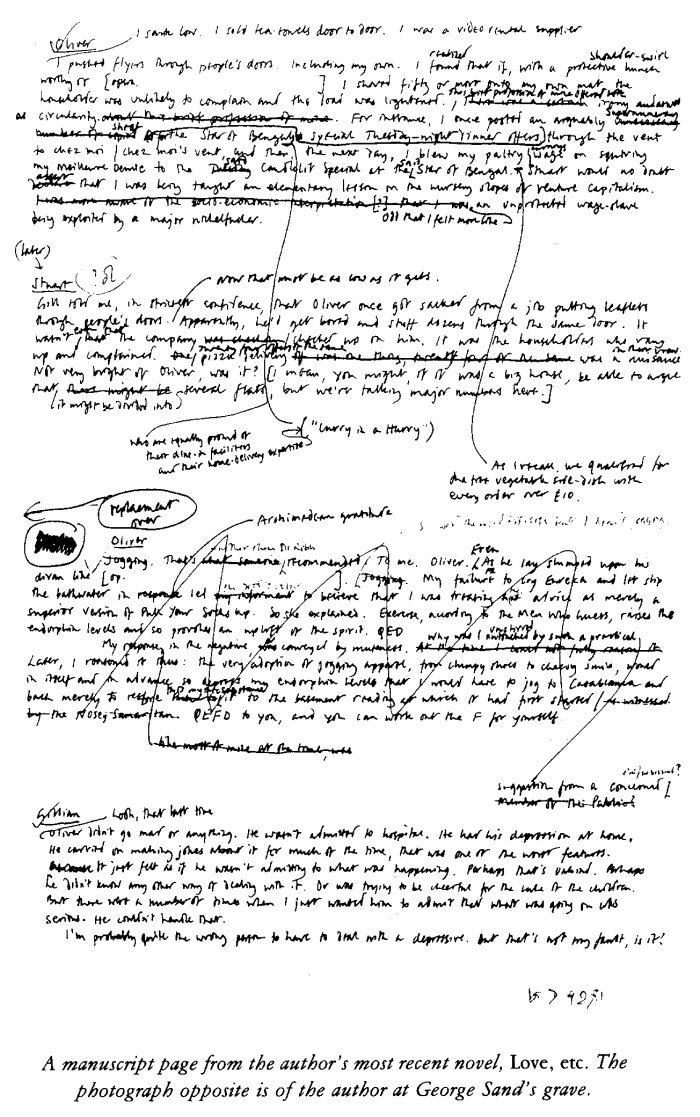
All the time. That’s when the real work begins. The pleasure of the first draft lies in deceiving yourself that it is quite close to the real thing. The pleasure of the subsequent drafts lies partly in realizing that you haven’t been gulled by the first draft. Also in realizing that quite substantial things can be changed, changed even quite late in the day, that the book can always be improved. Even after it’s published, for that matter. This is partly why I’m against word processors, because they tend to make things look finished sooner than they are. I believe in a certain amount of physical labor; novel-writing should feel like a version—however distant—of traditional work.INTERVIEWER
So you write by hand?BARNES
I wrote Love, etc. by hand. But normally I type on an IBM 196c, then hand correct again and again until it’s virtually illegible, then clean type it, then hand correct again and again. And so on.INTERVIEWER
When do you let go? What makes you feel it is ready?BARNES
When I find that the changes I’m making are dis-improving my text as much as improving it. Then I know it’s time to wave good-bye.INTERVIEWER
What do you use your computer for, then?BARNES
I use it for e-mail and shopping.INTERVIEWER
What are your plans for the future?BARNES
I’m not going to tell you! I’m a bit superstitious. Actually it is not so much superstitious as practical. The last piece of journalism I wrote was for The New Yorker about the Tour de France. Much of it was about drug use in professional cycling. I did a lot of research, and I found myself—unusually for me—talking about the research to people. When I came to write the piece I was a bit flat. I found it very difficult to write. I’d come back from having talked to, say, a Dutch sociologist of cycling about the history of drug taking back in the 1890s, and I’d spill it all out to everyone I met—because it’s quite fascinating—and then I’d sit down to write it, and I’d think, Is this really so interesting? That was confirmation of a lesson I’d learned long ago but momentarily forgotten: don’t talk it all away. It’s a matter of self-preservation. I’m retentive by nature anyway. But there will be other books, don’t worry.
Author photograph by Nancy Crampton.
Fiction
Anne Enright, Pale Hands I Loved, Beside the ShalimarKarl Iagnemma, On the Nature of Human Romantic Interaction
David Leavitt, Crossing St. Gotthard
Interview
Beryl Bainbridge, The Art of Fiction No. 164Julian Barnes, The Art of Fiction No. 165
Poetry
Christopher Bakken, Three PoemsGeorge Bradley, Nabu-Kudurri-Usur and the Word
Michael Burns, Two Poems
Elena Karina Byrne, Sanctuary of Hunger
John Canaday, A True Story
Kevin Cantwell, Portrait of Adele Bloch-Bauer
Cassandra Cleghorn, Three Poems
Laurie Clements, The Shaking
Craig Crist-Evans, Heron
Nicole Cuddeback, Two Poems
Angie Estes, Vermeer Fever
Jenny Factor, To Twenty Canada Geese In the Palisades Industrial Park
Patricia Ferrell, Five Poems
Gary Fincke, Four Poems
Mary Gannon, Ghost
Faye George, Three Poems
Stuart Greenhouse, Four Poems
Lois Hirshkowitz, Two Poems
Karen Holmberg, The Perseids
Benjamin Ivry, Four Poems
Paul Kane, Two Poems
Carol Stevens Kner, Masters of the Renaissance
Cynthia Kraman, Ride to Manhattan (with Rainbow)
Timothy Liu, Four Poems
Michael McFee, Spigot with Imaginary Animals
Stephen McLeod, Maria Gostrey
W. S. Merwin, Three Poems
M. Minford-Meas, Bone Ceremony
Carol Moldaw, The Lightning Feld
Joan Murray, Toby's Body
Christopher Patton, Broken Ground
Rodney Phillips, Two Poems
James Pollock, Northwest Passage
Francis Ponge, La Rage de l'expression
Burton Raffel, An Autumnal
Robert Richman, Getting to Know the Infinite
Pattiann Rogers, Archetype
Kenneth Rosen, Four Poems
David Schloss, Two Poems
Ann Snodgrass, Fugue, 1942
Andrew Towle, Two Poems
Wyatt Townley, Distant Lessons
Meredith Trede, Two Poems
Michael Tyrell, Two Poems
Brian Wickers, Marginal Questions, Winter, English 101, Frost
Alison Woods, Two Poems
Wahn Yoon, Portfolio
Feature
Terry Quinn, Dear Bunny, Dear VolodyaEdmund White, The Flaneur
Art
Nancy Friedemann, Maps, Fingerprints, Sequences